

An AI-based integrated management system that prevents failures in advance
Transforming Elevator Operations
into a Data-Driven Model with the SPTM Integrated Management System
SPTM (Songsan Prevent Trouble Maintenance System) is a next-generation preventive maintenance solution that detects abnormal signs of failure in advance based on equipment data, and maximizes safety and efficiency through predictive maintenance.
- -Minimizes failures and downtime through predictive maintenance
- -Integrated management of UAM, heliports, drones, and special facilities on a single dashboard
- -Supports investment and operational decision-making with data-driven reports
- Why is SPTM Necessary?
-
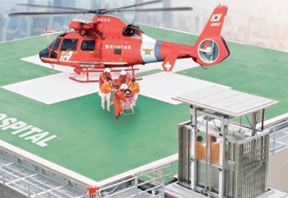
SONGSAN's special environment facilities, including UAM vertiports, heliports, 60-ton Goliath elevators, explosion-proof systems, and underground and inclined elevators, cannot be sufficiently managed through conventional maintenance methods.
- Sudden failures causing operation downtime and safety risks
- Maintenance cycles and part replacement timing relying solely on experience without data
- Difficulty in real-time monitoring of safety conditions for heavy-load and extreme environment equipment
- Structural limitations in managing multiple site facilities simultaneously
- SPTM
-
SongSan Prevent
Trouble Maintenance
- Why SPTM Provides the Solution
-
SPTM is SONGSAN's proprietary smart platform that predicts failures before they occur and integrates the management of operations, maintenance, security, and safety data.
- Minimizes failures and downtime through AI-based predictive maintenance
- Real-time condition monitoring integrated with remote control (RCM)
- Component lifespan analysis and automatic maintenance scheduling
- A scalable data platform extending to UAM, drones, and heliports
SPTM System Architecture
-
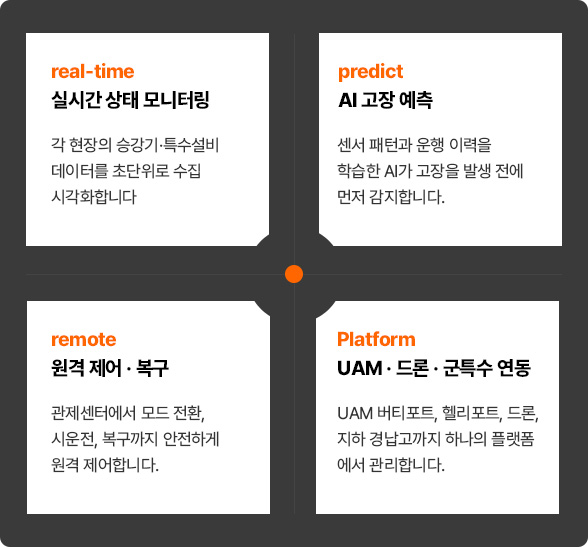
COME
Real-Time Operation Monitoring
Key data such as speed, vibration, temperature, and load are collected and visualized in real time.
-
AI
Failure Prediction
AI detects abnormal signs in advance and predicts potential risk levels.
-
LIFE
Component Lifecycle Management
Cumulative usage data of key components (motors, doors, brakes, and guides) are analyzed to recommend replacement timing and predict remaining service life.
-
RCM
Remote Control & Recovery
Integrated with the RCM (Remote Control Module), it supports safe remote control functions such as remote mode switching, test operation, and emergency reset.
-
PATTERN
Operation Pattern Optimization
By analyzing peak-time operation patterns, it proposes optimal operating strategies for each facility and simultaneously improves energy and operational efficiency.
-
ALERT
Automatic Fault & Event Classification
Events are automatically classified into three levels (warning, caution, and critical) allowing priority response sites to be identified at a glance.
-
SCHEDULE
Maintenance Schedule Generation
Inspection and maintenance schedules are automatically generated based on predictive results and operation history, with notifications sent to maintenance teams and administrators.
-
REPORT
Automated Reporting
Daily, weekly, and monthly operation, fault, and maintenance reports are automatically generated, enabling data driven management insights.
-
UAM
UAM & Vertiport Integration
Vertiport elevators and boarding systems are integrally controlled by linking with UAM flight schedules and passenger information.
-
DRON
Drone Station Integration
Vertical mobility and logistics flows linked to drone takeoff, landing, charging, and payload transfer facilities are managed together through SPTM.
-
EXTREME
Extreme Environment Mode (Underground & Confined Spaces)
The system instantly detects the status of equipment specialized for explosion-proof, flame-retardant, and waterproof environments, and automatically switches to safety mode in emergency situations.
-
CENTER
Integrated Control Center Operation
All regions and project sites are centrally operated through a single control interface, supporting collaboration among equipment, organizations, and maintenance teams.
SPTM Core Functions
-
- Sensor Layer
-
- LiDAR / cameras / encoders
- Motor, hydraulic, vibration, and temperature sensors
- Door status, load, and speed signals
- Drone and UAM position data
-
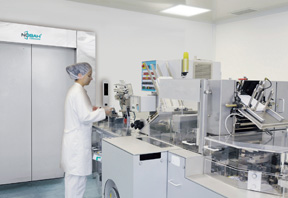
- Edge & Gateway
-
- Video and sensor data preprocessing
- Object recognition and environmental awareness AI
- Primary anomaly detection and safety filtering
- Secure communication between sites and control centers
-
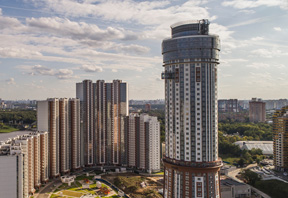
- AI & Data Platform
-
- Failure prediction algorithms
- Component lifecycle and pattern analysis
- Operation and maintenance history database
- Reporting and dashboard engine
-
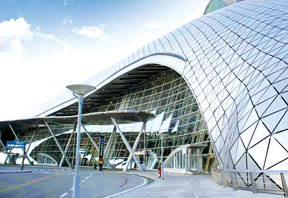
- Operation & UI
-
- Integrated control center monitoring
- Mobile applications for field and maintenance teams
- Remote control and mode switching
- Customer and operator portals
Effects of SPTM Implementation
SPTM is not merely a monitoring system,
but a platform that transforms equipment operation into a data-driven model.
- # Reduced Failure and Incident Rates
- # Minimized Downtime
- # Reduced Maintenance Costs
- # Enhanced Safety and Reliability
- # Data-Driven Decision Making
SPTM Application Areas
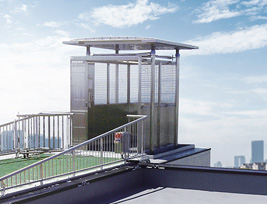
- UAM vertiport and heliport elevators
- High-capacity, industrial, and explosion-proof elevators
- Subway, airport, port, and special vertical transportation facilities
- Drone elevators and drone station-integrated facilities
- Airport, port, and large-scale plant special elevator systems
- Future mobility infrastructure (eVTOL, etc.)